 The Campaign for Grade-Level Reading
November 2014
The Campaign for Grade-Level Reading is a collaborative effort by funders, nonprofits, government agencies, business leaders, states and communities across the nation to ensure that many more children from low-income families succeed in school and graduate prepared for college, a career and active citizenship.

Join the 60+ GLR Communities Measuring Progress with Our Self-Assessment Tool
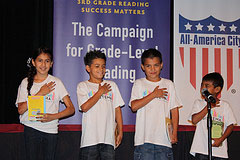 There is still time for GLR communities to fill out the Campaign’s Community Self-Assessment Tool, but keep in mind that the December 1 deadline is right around the corner. The self-assessment tool allows our communities to review and update their Community Solutions Action Plans (CSAPs): what they have done to address school readiness, chronic absence and summer learning loss using strategies such as parent engagement, building healthy readers and conducting state-level outreach. It also provides the GLR Campaign with valuable data on where our communities stand and how to honor them as we consider the 2014 Pacesetter Awards in December.
More than 60 communities from 13 different states have begun filling out — or have already completed — their self-assessments. Join them today and update your CSAP using our online self-assessment tool or a downloadable PDF. Self-nominations are due by December 1.
November Events Convene GLR Campaign Stakeholders Across the Nation
November brought a number of occasions to share news about the Campaign, celebrate progress to date and look to the work that lies ahead. GLR Campaign Managing Director Ralph Smith spoke at Campaign Partner Scholastic’s Family and Community Engagement Symposium in California before traveling to Indian River County, Florida, to celebrate a Community Day of Service organized by the county’s Moonshot Moment GLR campaign.
We hosted a November 18 reception at the annual Summer Changes Everything™ conference of the National Summer Learning Association, a GLR Campaign Partner. On November 20, GLR communities in Texas convened at a regional huddle held in conjunction with a conference sponsored by the National League of Cities, also a GLR Campaign Partner. The GLR Campaign, The Winthrop Rockefeller Foundation and the Southern Education Foundation co-hosted a November 13 Funder Huddle during the Southeastern Council of Foundations annual meeting to discuss the landscape in the South and the imperative and opportunity for moving the needle on grade-level reading in southern states.

Stories Spotlight GLR Campaigns Making a Difference in Arizona and Springfield, Massachusetts
 The successes of GLR campaigns in Arizona and Springfield, Massachusetts, demonstrate the effectiveness of collaborative, community efforts on early reading education. Read On Arizona, launched in 2012, is a powerful coalition of philanthropic, public and private community stakeholders that has quickly made strides on statewide reading proficiency. When a state law passed in summer 2014 that required Arizona students scoring poorly on reading proficiency to repeat third grade, far fewer children than expected scored in the “falls far below” proficient category that triggers retention thanks to Read On Arizona’s efforts to coordinate literacy efforts statewide.
 In Springfield, Massachusetts, the Irene E. & George A. Davis Foundation has been leading the way on a similar approach, convening community partners to help move the needle on third-grade reading proficiency. A critical partner in this work is Strategies for Children, a Boston-based group that works on research, advocacy and policies around early education. The two worked together to develop a blueprint of initiatives and practices used by Springfield’s GLR campaign, called Reading Success by 4th Grade, to work toward the goal of third-grade reading proficiency for 80 percent of Springfield’s children by 2016. The initiatives include Talk/Read/Succeed!, Springfield College Reading Corps, Ready for Kindergarten, the Family Child Care Language and Literacy Project, Stay in School Springfield and the Hasbro Summer Learning Initiative.
Holyoke, Massachusetts, Early Literacy Initiative Receives Gateway Cities Innovation Award
The Holyoke Early Literacy Initiative (HELI) was recently presented the 2014 Gateway Cities Innovation Award. The award recognizes HELI for its outstanding citywide effort to ensure that 100 percent of Holyoke’s children are reading on grade level by the end of third grade. HELI has brought the city government, school board and community organizations together to develop an early literacy blueprint. The award was presented at MassINC’s annual Gateway Cities Innovation Awards & Summit on November 13 in Boston.
Montgomery County/Dayton, Ohio, Is Working to Prevent Summer Slide
A century’s worth of research shows that students lose ground academically when they are out of school for the summer, especially those from low-income families. With that in mind, Learn to Earn Dayton, partnering with Building Educated Leaders for Life (BELL), launched a summer program at several local schools to prevent “summer slide.” The program places heavy emphasis on reading, and students are seeing tangible benefits — gaining as many as four months of reading proficiency — by the time they return to school in the fall.
November’s Bright Spots Communities Highlight Promising Summer Learning Efforts
Our Bright Spots Communities this month offer techniques for keeping children reading during the summer, as well as engaging under-resourced families in literacy activities throughout the entire year.
- Tahoe Truckee, California The Neighborhood Summer Reading Program in Tahoe Truckee sponsors teachers’ visits to isolated mobile home parks during the summer to provide literacy activities and reading time.
- Quad Cities, Iowa/Illinois The free, six-week Summer Enrichment Program in Quad Cities served 295 elementary school-age children from low-income families in 2014, increasing literacy scores by an average of 9.3 percentage points.
- Buffalo, New York A site of the Parent-Child Home Program provides two years of intensive, twice-weekly home visits to under-resourced families with children between age 16 months and 4 years. Early literacy specialists demonstrate dialogue to promote language development, cognitive skills and social competencies that help children enter school with the skills to be successful.
- New York City New York City’s Once Upon a Summer program provides opportunities for summer learning and extended learning for children in the area’s poorest neighborhoods.

Vroom App Helps Parents Become “Brain-Builders” for Their Children
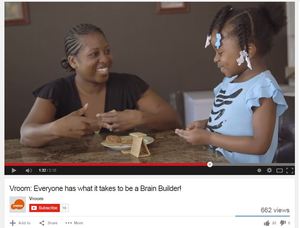 Because parents are the first and most important teachers in their children’s lives, they play an essential part in assuring readiness for school and preparation to succeed later in life. Just in time for the holiday season, the Vroom app provides daily tips for parents on how to best interact with their children in order to have a positive impact on their brain development.
The app is available in both English and Spanish on all smartphone platforms. A series of accompanying videos, also bilingual, explain the importance of parents serving as “brain-builders” for their children and how the Vroom app can help.
Creative Alternatives to Retention to Ensure Students Are Reading by 3rd
Education Week hosted a webinar on November 19 that addressed ways to improve reading skills in young children that do not include holding children back in school. The webinar featured two guest speakers: Krista Calvert of Kansas City Public Schools (Missouri) and D. Ray Reutzel of Utah State University. Calvert highlighted a program in her district called Literacy Lab Classroom Cohort, where 18 classrooms are open for teachers and administrators to observe literacy best practices in action. Reutzel said retention as a means to improve reading skills was only effective 5 percent of the time and was not a viable solution. Instead, speakers offered examples of early intervention that help children improve reading skills, such as one-on-one instruction and increasing the amount of reading curriculum for children who are struggling to read on grade level.

The National Center for Families Learning is now accepting nominations for the 2015 Toyota Family Teacher of the Year Award. The selected educator’s school or program will receive a $20,000 prize to further efforts to engage families in learning together. Educators working with families through schools, libraries and many other community-based organizations will be considered. Educators can be nominated via a brief online application. The deadline to apply is December 31, 2014. For more information, click here.
The Express Scripts Foundation funds state and local initiatives that support school readiness and improve literacy to help prepare underserved youth for higher education and success in life. Grant amounts range from $500 – $200,000. Deadlines are March 1, June 1, September 1, and December 1, annually. Click here for more information.

New School Report Highlights Correlation Between Poverty and Chronic Absence, Offers Solutions
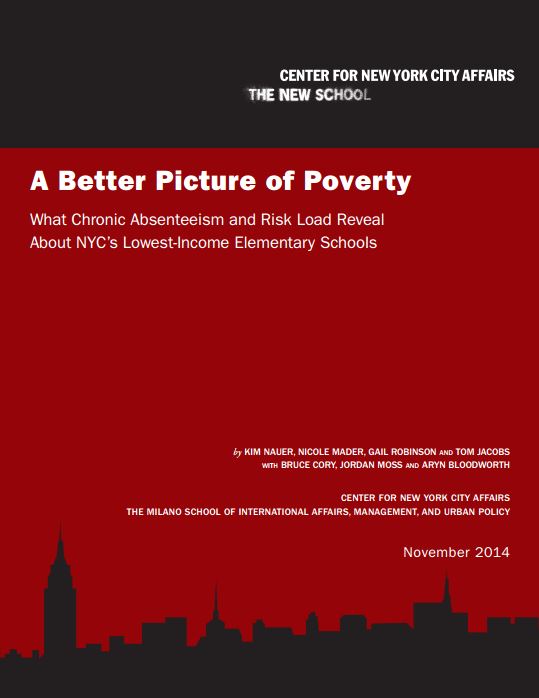 The correlation between poverty and chronic absence from school is strong, but not inevitable, according to a new report from The New School for Public Engagement’s Center for New York City Affairs. “A Better Picture of Poverty: What Chronic Absenteeism and Risk Load Reveal About NYC’s Lowest-Income Elementary Schools” shows chronic absenteeism’s profound effect on the academic success of students from low-income families and argues that it should be a priority for mayors when considering programs designed to help students overcome poverty-related educational issues.