 The Campaign for Grade-Level Reading
August 2015
The Campaign for Grade-Level Reading is a collaborative effort by funders, nonprofits, government agencies, business leaders, states and communities across the nation to ensure that many more children from low-income families succeed in school and graduate prepared for college, a career and active citizenship.

Make Attendance Count in September
.jpg "aam_badge (1)") As the leaves start to change and children head back to school, GLR communities across the country are focusing on reducing chronic absence. September is Attendance Awareness Month (AAM), and Attendance Works is offering an array of resources for parents, educators and advocates:
As the leaves start to change and children head back to school, GLR communities across the country are focusing on reducing chronic absence. September is Attendance Awareness Month (AAM), and Attendance Works is offering an array of resources for parents, educators and advocates:
- A toolkit detailing strategies for intervening with chronically absent students and communicating effectively about attendance;
- A video on engaging parents to fight chronic absence;
- Promotional materials, including social media posts, banners and flyers to display in schools and offices, decals, infographics and more; and
- An attendance awareness “house party” planning kit with handouts and a sample agenda.
When you stop by to check out the new materials, don’t forget to post your AAM plans on theAttendance Awareness Map.

West Virginia Partners with Attendance Works on New Initiative
 The West Virginia Department of Education (WVDE) kicked off a statewide attendance initiative this month. WVDE has signed on with Attendance Works to provide materials and facilitate activities for parents, teachers, schools and students that help promote regular attendance. State Superintendent Dr. Michael Martiranomade the announcement at several Wayne County schools, calling regular attendance “a critical habit that must be instilled among our students at an early age.”
The state of West Virginia officially joined the GLR Campaign last month, with all 55 counties committing to work to increase the number of children reading at grade level by third grade. WVDErecently requested about $800,000 in new state funds for efforts to improve literacy among the state’s youngest learners.
Buffalo GLR Campaign Recognized by Local Editorial Board
The local GLR campaign in Buffalo, New York, was recognized this month for its “crucial” work by the editorial board of the Buffalo News. Read to Succeed Buffalo was named a 2014 Pacesetter community for its measurable progress on student readiness. During the 2013-14 school year, the percent of Buffalo City Schools students testing at or above reading benchmarks improved from 79 percent at the beginning of the year to 95 percent by the end of the year.
August’s Bright Spots Communities Keep Kids Reading All Summer Long
Our Bright Spots Communities this month are getting books into the hands of children in low-income families to keep them reading over the summer:
- Richmond, California West County Reads’ Take it, Leave it Bookshelf program puts about 10,000 books per year in locations frequented by low-income families, such as laundromats, barber shops and churches.
- Vernon, Connecticut Vernon’s public library is among libraries in four Connecticut communities to receive a grant to develop a program combatting the summer slide. In 2015, the third summer of the “READy for the Grade” initiative, 150 children ages 5 to 8 participated across all four communities.
- Tampa, Florida The Summer Care program began as an effort to bolster low-income families’ financial stability. Now, it works to help those families’ children improve their reading proficiency over the summer.

Baltimore Event Spotlights Healthy Housing for Children in Low-Income Families
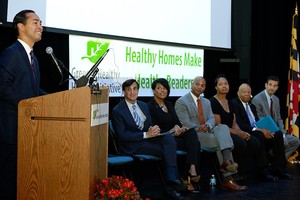 The Green & Healthy Homes Initiative (GHHI) and the Baltimore GLR Campaign this month welcomed U.S. Department of Housing and Urban Development Secretary Julián Castro to Baltimore for an event highlighting the connection between healthy housing and better educational outcomes. Castro announced a nearly $4 million grant to the city to reduce hazards in low-income housing that can create health problems for children and hold them back in school.
Putting Plans into Action to Address Achievement Gaps
The Davenport Community School District in Iowa and the Sarasota County School District in Florida each formed task forces in 2014 to address achievement gaps by race and income. In Davenport, the Achievement Gap Working Group has identified about 200 third-, fourth- and fifth-grade students who scored in the bottom quartile in reading last year. The Sarasota task forcefound that Sarasota County has the fourth-lowest rate in the state of black students identified as gifted. Both groups made recommendations to their local school boards that will start to take effect this year.
Program Combats Summer Slide among Homeless Youth in California
The summer slide is particularly severe for children in low-income families, some of whom may experience homelessness during the summer months. The “School on Wheels” program in Los Angeles aims to support those children, providing books, activities and homework help to homeless youth in the Skid Row neighborhood. School on Wheels typically serves more than 700 children each summer.

Massachusetts Governor Announces $6.3 Million in Preschool Grants
Massachusetts Governor Charlie Baker last week announced $6.3 million in grants to support high-quality preschools through the state’s Universal Pre-Kindergarten program. The grants were awarded to more than 500 early education and child care programs to improve school readiness in the state.

Larger Oral Vocabulary by Age 2 Predicts Better Kindergarten Readiness
Children with larger spoken vocabularies by age 2 tend to arrive at kindergarten better prepared academically and behaviorally than their peers, according to a new study by researchers at the Pennsylvania State University, the University of California, Irvine, and Columbia University. The study found that children from higher-income families tended to develop larger vocabularies at a very young age.
States Vary Widely in Preparing Teachers for Literacy Instruction
Standards and criteria for preparing new teachers for literacy instruction are strikingly inconsistent across states, according to a new report from the International Literacy Association (ILA). ILA’s Preliminary Report on Teacher Preparation for Literacy Instruction examines guidelines for teacher preparation in literacy in all 50 states.