 The Campaign for Grade-Level Reading
June 2014
The Campaign for Grade-Level Reading is a collaborative effort by funders, nonprofits, government agencies, business leaders, states and communities across the nation to ensure that many more children from low-income families succeed in school and graduate prepared for college, a career and active citizenship.

Successes, Challenges and Opportunities Shared at Funder-to-Funder Huddle
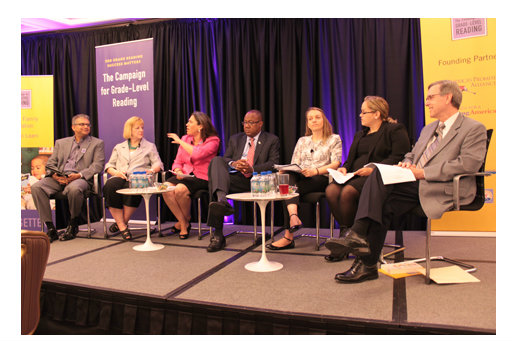 On June 6-7, the GLR Campaign’s “Funder-to-Funder Huddle” brought together national, regional, state and local investors in grade-level reading work across the country to thank them for their commitments and provide opportunities for further collaboration. The Huddle featured lively presentations and discussions of challenges, solutions and mechanics of what’s working and what remains to be done. Featured speakers included GLR community investors; Jim Shelton, Assistant Secretary at the U.S. Department of Education; and a panel of federal officials who discussed early learning initiatives at the national level. The event came on the heels of commentary in the Philanthropy News Digest authored by the GLR Campaign’s Chief Operating Officer Leslie Boissiere and Senior Fellow Patrick Corvington describing how collaborative efforts are amplifying this important work.
A full write-up of the Huddle can be found here.
Campaign Pacesetter Program Honors Beutner Family Foundation for Vision To Learn
The GLR Campaign this month honored the Los Angeles-based Beutner Family Foundation as a Pacesetter for its Vision To Learn program. Addressing vision problems that keep many low-income children from succeeding in school, Vision To Learn has provided free eye exams to more than 21,000 children and free glasses to 16,000 of them. The Pacesetter award reflects the program’s contribution to improving academic achievement and, with that, life prospects for young children in California.
UPS & Its Employees Donate $5 Million to United Ways for Early Reading
UPS and its employees are donating more than $5 million to support grade-level reading work being done by United Ways across the country, United Way announced this month. The substantial donation to United Way represents a decision by UPS employees to dedicate their contributions to ensuring that more low-income children have a strong foundation in education.
The investment will benefit United Ways in nearly 100 communities that are currently working closely with the Campaign for Grade-Level Reading to promote early reading skills. Eduardo Martinez, who heads The UPS Foundation, says company employees believe in the power of education and appreciate the Campaign’s emphasis on third-grade reading proficiency.

Michelle Obama, GLR Communities Promote Summer Learning
 At least 96 GLR communities took action in June to celebrate Summer Learning Day and promote summer reading, joining a nationwide push that included First Lady Michelle Obama. The First Lady stopped by the U.S. Department of Education on June 20 for an event with the National Summer Learning Association (NSLA). She stressed the importance of programs that encourage learning during the summer months and encouraged all youth to continue to “Read, read, read,” adding “because reading might be the most important thing you can do for your future.”
Summer learning was also the theme of a June 10 forum at the New America Foundation, held in partnership with the GLR Campaign, NSLA and the Joan Ganz Cooney Center at Sesame Workshop. The forum explored how parent engagement and technology can expand summer learning.
In the communities:
- A partnership with myON, the world’s largest interactive digital library, is allowing several GLR communities to offer free access to digital reading materials for children throughout the summer months.
- Summer learning programs, child care centers, schools, libraries and camps across Atlanta and Georgia stopped what they were doing at 10 a.m. on June 20 to read with children, and shared their celebrations on social media using the hashtag #AtlantaReads.
- In Dayton, Ohio, the regional transit agency joined the summer reading effort by placing books at each of their transit centers and launching its own Read On! RTA campaign.
Bright Spots Communities Highlight Promising Efforts
Bright Spots showcase the work that the Grade-Level Reading Communities Network is doing to make progress on school readiness, school attendance and summer learning. Communities featured in June include:
- Dubuque, Iowa, has combined its grade-level reading work with a longstanding cradle-to-career initiative to strengthen community awareness and engagement in improving children’s prospects for the future.
- Wake County, North Carolina: WAKE Up and Read collected nearly 70,000 books in a spring book drive to help disadvantaged children build literacy skills before reaching kindergarten.
- Austin, Texas, collected data to determine demand for summer learning programs. Leaders are now discussing better ways to align these programs and make them accessible to all children.
- Seattle, Washington, is working to engage families in summer reading efforts through the area’s “Let’s Read!” campaign, distributing books to children from low-income families.
You can nominate your community for a Bright Spot by emailing Betsy Rubiner.
Strategies for Children Recognized for “Excellence in Advocacy”
The Massachusetts Nonprofit Network presented the “Excellence in Advocacy” award this month to Strategies for Children for its work to ensure that all children in Massachusetts have the opportunity to achieve educational success. Strategies for Children, a key partner in our GLR work, strives to ensure that children have access to high-quality early education, are entering elementary school ready to succeed and are proficient readers by the end of third grade.
To share updates on your community’s efforts, email Phyllis Jordan at pjordan@gradelevelreading.net.

American Academy of Pediatrics Prescribes Reading
Acknowledging the importance of reading proficiently by the end of third grade, the American Academy of Pediatrics is urging doctors and health providers to talk to parents of young children about the importance of reading aloud. The policy statement released in June points to research that shows reading and talking with children helps develop strong language skills, literacy development and parent-child relationships.
The statement dovetails with the work done by Reach Out and Read, which distributes 6.5 million books a year through medical providers at 5,000 sites.
U.S. Conference of Mayors Adopts Resolution to Build Early Learning Nation
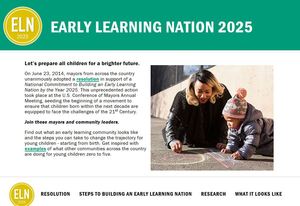 Mayors from across the country unanimously adopted a resolution in June supporting a National Commitment to Building an Early Learning Nation by the Year 2025. This resolution, approved at the U.S. Conference of Mayors Annual Meeting, helps launch a movement to ensure that children born within the next decade are equipped to face the challenges of the 21st Century.
A new Early Learning Nation 2025 website, created by the Bezos Family Foundation, promotes the work already going on in cities, including several in the GLR Communities Network. Cities are invited to share the work they are doing on the website as the movement grows. Also be sure to like the ELN 2025 Facebook page: facebook.com/eln2025 and follow on Twitter: @eln2025
NYC United Way Receives $52 Million to Combat Chronic Absence
The New York City Department of Education has awarded a four-year, $52 million grant to the United Way of New York City (UWNYC) to fight chronic absence through its Community Schools program — the largest education grant ever given by the city to a nonprofit organization. Improving attendance is a key strategy for UWNYC’s Community Schools, which offer in-school mental health services, homework help and family counseling alongside classroom instruction.
Schools will submit proposals over the summer, with the amount of each school’s grant depending on the size of the school.

 Two Grant Opportunities Support Family Engagement
The National Center for Families Learning (NCFL) is seeking organizations that engage families and communities in learning activities to join the Toyota Family Learning movement by applying for a three-year, $175,000 grant. Toyota Family Learning is the latest initiative offered by the NCFL-Toyota partnership, which supports programs at 261 sites in 52 communities and 30 states. For more information on applying for grants, click here.
The federal Administration for Children and Families has announced a new $500 million grant opportunity to expand access to high-quality, comprehensive services for low-income infants and toddlers and their families. This includes creation of Early Head Start-Child Care (EHS-CC) Partnerships and expansion of Early Head Start services. The deadline is August 20. Apply here.
Afterschool Programs Eligible for Dollar General Grant
The Afterschool Alliance and the Dollar General Literacy Foundation are seeking nominations for the first ever Dollar General Afterschool Literacy Award. $10,000 will go to an exemplary afterschool program that is providing literacy support and guidance to middle schoolers. Nominations must be received by August 15. Click here to learn more and apply.

New Study Measures Impact of Reading Partners Tutoring Program
Reading Partners, a one-on-one tutoring program using volunteers to assist struggling readers in low-income elementary schools, is making important gains according to new findings by MDRC. A random assignment study of Reading Partners in 19 schools in three states found that the program had a positive and significant impact on the reading proficiency of second- to fifth-grade students, equal to 1.5 to 2 months of growth in literacy achievement. Read the full study here.
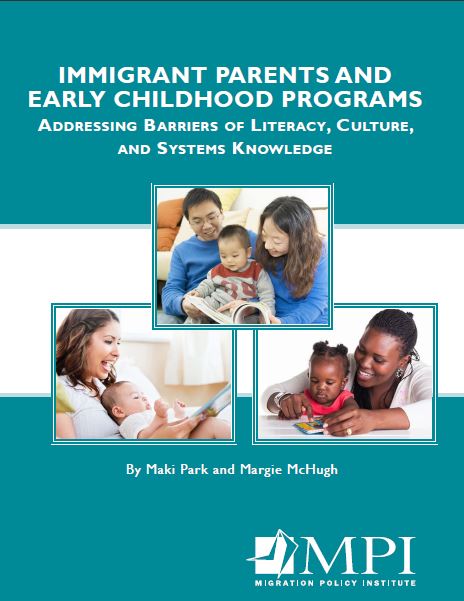 Immigrant Parents and Early Childhood Programs: Addressing Barriers of Literacy, Culture and Systems Knowledge
A new report from the Migration Policy Institute identifies the unique needs of immigrant parents in terms of meeting the expectations for parent skill, engagement and leadership sought by early childhood education and care programs, and outlines strategies to address these needs. The study is based on field research in six states, expert interviews, a literature review and a socio-demographic analysis.