 The Campaign for Grade-Level Reading
December 2014
The Campaign for Grade-Level Reading is a collaborative effort by funders, nonprofits, government agencies, business leaders, states and communities across the nation to ensure that many more children from low-income families succeed in school and graduate prepared for college, a career and active citizenship.

White House Summit on Early Childhood Education Marks Launch of “Invest in US” Partnership
 December offered an opportunity to amplify our message on a truly significant stage: The White House Summit on Early Childhood Education in Washington, D.C. The December 10 summit served as the launching point for Invest in US, a cross-sector initiative by the GLR Campaign, practitioners, advocates, policymakers and philanthropists to promote greater investments in early education and school readiness. Campaign Managing Director Ralph Smith participated in a panel discussion at the event focused on the expansion of private investment in early learning.
President Barack Obama announced $1 billion in public-private spending on early education programs at the summit, calling it “one of the best investments we can make.” Eighteen states were awarded a total of $250 million in Education Department grants to create or expand high-quality preschool programs. Those states include: Alabama, Arizona, Arkansas, Connecticut, Hawaii, Illinois, Louisiana, Maine, Maryland, Massachusetts, Montana, Nevada, New Jersey, New York, Rhode Island, Tennessee, Vermont and Virginia.

Literacy Coalition of Onondaga County Holds Second Annual “Stories of the Season” Event
The Literacy Coalition of Onondaga County based in Syracuse, New York, held its second annual “Stories of the Season” event this month, highlighting the importance of families reading to and with their children. The Literacy Coalition has partnered with Dolly Parton’s Imagination Library to send a new book each month to children in Syracuse from birth to age 5.
Georgia’s “Talk With Me Baby” Highlighted in White House Blog
Georgia’s “Talk With Me Baby” (TWMB) initiative was recognized by President Obama at the White House Early Education Summit, and Arianne Weldon — a TWMB member and director of Get Georgia Reading — was featured in an interview on the White House blog. TWMB is a broad public health coalition focused on providing early language exposure to babies, especially those from lower-income families.
Arkansas Receives Federal Pre-K Funding After State-Level Campaign Draws National Attention
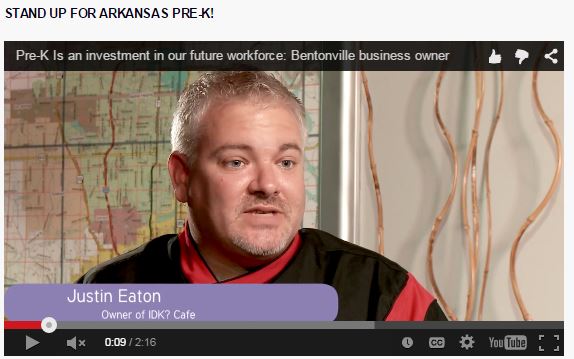 State-level advocacy efforts by the Arkansas GLR Campaign (AR-GLR) drew attention at the federal level, as the state was awarded $15 million in federal pre-K funding at the December 10 White House Summit. The campaign has been hard at work over the past several months in efforts to secure enough funding to expand access to pre-K to more children in the state and offer additional support for existing programs. AR-GLR released a series of videos from parents, educators and business leaders on the importance of pre-K and orchestrated a November 17 “Thunderclap” — a Twitter campaign calling for increased pre-K funding — that reached more than 104,000 people.
December’s Bright Spots Communities Promote Collaborative Summer Learning Efforts
Our Bright Spots Communities this month offer techniques for keeping children reading during the summer:
- Sarasota, Florida Third-grade reading proficiency at Alta Vista Elementary jumped more than 35 percent in 2014 as a result of a collective effort led by the Community Foundation of Sarasota County. Among the more than 25 organizations that are part of this collective effort focused on school readiness and summer learning loss is the Patterson Foundation, which also is a GLR Campaign co-investor.
- Dayton, Ohio More than 800 high-risk students in two summer programs made significant strides in literacy and reading. The programs, operated by Building Educated Leaders for Life (BELL) and Freedom Schools, were part of a community effort to expand summer learning options led by Learn to Earn Dayton/ReadySetSoar.

Award-Winning Literacy Apps Not Always Popular with Parents
Families and educators increasingly are using apps to help children learn critical literacy skills, but they are not downloading the apps that have won awards from media rating groups, according to EdCentral. Part 3 of EdCentral’s “Snapshot of Kids’ Language and Literacy Apps” series finds that just 17 percent of award-winning language/literacy apps are among the 50 most popular educational apps on iTunes, Google Play and/or Amazon, suggesting that there may be a disconnect between what parents buy for their children and what experts think will work. EdCentral also found that award-winning apps tend to cost a bit more than the most popular apps. Click here to read Part 1 and Part 2 in the series.
Last year, the GLR Campaign partnered with PBS to create the PBS Parents Play & Learn App, a bilingual program that helps parents build their children’s math and literacy skills. Learn more about the Campaign’s efforts to promote technology for successful parenting here.
Sneak Peek of Scholastic’s Kids & Family Reading Report
Scholastic won’t release its biannual Kids & Family Reading Report until January 2015, but a sneak preview of the report’s findings is available now, providing some insight into what kids want from the books they read for fun. Among the figures in the preview: 73 percent of kids ages 6-17 say they would read more if they could find more books they like, and younger kids want more books with characters who look like them.

The BUILD Health Challenge is a national award program designed to support community collaborations that are working to give everyone a fair chance to be healthy. Specifically, the program awards planning grants of up to $75,000 and implementation grants of up to $250,000 to strengthen partnerships among hospitals, nonprofits, local health departments and other community organizations to improve the health of low-income neighborhoods in cities with a population of 150,000 or greater. Round I applications must be received no later than January 16, 2015. For more information, click here.

Putting Learning on the Map: Visualizing Opportunity in 21st Century Communities
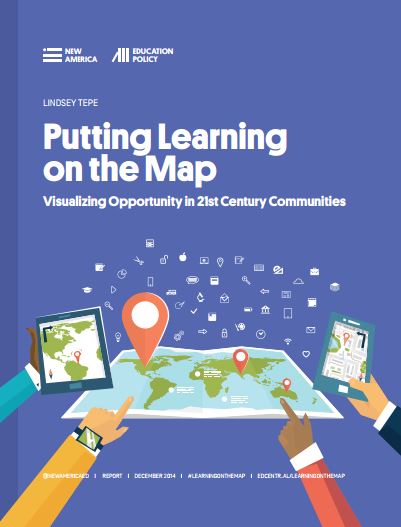 In a recent paper for the New America Foundation’s Education Policy Program, Lindsey Tepe makes the case for utilizing new mapping tools to help communities visualize educational inequalities and opportunities. With educational gaps between high- and low-income students developing so early, Tepe argues that mapping can reveal the resource disparities and unique local needs that should be addressed in order to give every child a high-quality education. Putting Learning on the Map: Visualizing Opportunity in 21st Century Communities highlights examples of effective mapping and analysis, from an FCC map of broadband access in Los Angeles school districts to a visualization of early childhood services in Philadelphia that led to $1 million in increased funding.
The Effects of Full-Day Kindergarten
A new study finds that full-day kindergarten may be substantially more effective than half-day programs, especially for Hispanic students. University of Virginia researcher Chloe R. Gibbs conducted a first-of-its-kind randomized trial of full-day kindergarten, finding sizable benefits for all students, but especially for Hispanic students and those with low literacy skills. Experimental Evidence on Early Intervention: The Impact of Full-day Kindergarten discusses how these results could help narrow or close the achievement gap early on.