 The Campaign for Grade-Level Reading
April 2015
The Campaign for Grade-Level Reading is a collaborative effort by funders, nonprofits, government agencies, business leaders, states and communities across the nation to ensure that many more children from low-income families succeed in school and graduate prepared for college, a career and active citizenship.

2014 Pacesetter States Recognized for Early Reading Work
The GLR Campaign has named eight states as 2014 Pacesetters for their efforts to boost early reading achievement among low-income children. The 2014 Pacesetters include Arizona, Arkansas, California, Colorado, Florida, Georgia, Iowa and Ohio. They were selected after a review determined that each had taken effective action to push the Campaign toward its 2020 goal of increasing by at least 100 percent the number of low-income third graders reading at grade level in 12 states or more.
“These states all have put a stake in the ground around third-grade reading,” said Ralph Smith, the managing director of the GLR Campaign. “As a group, they show that seeking to ensure more hopeful futures for vulnerable children is a bipartisan priority. And they are proving that there is no single pathway or approach and no substitute for hard work, collective action and a shared sense of urgency.”
The GLR Campaign recognized 30 communities as 2014 Pacesetters in March. Click here to see the full list, along with individual profiles of each community or state.
GLR Campaign Hosts 2015 Funder-to-Funder Huddle
On April 23-25, more than 150 national, state and local funders and special guests gathered in San Francisco for the Second Annual Grade-Level Reading Funder-to-Funder Huddle. Participants shared strategies of what’s working, learned about new co-investment opportunities, honored the 2014 Pacesetters, connected with peers and heard a special presentation about smart and sensible third-grade reading policy.
Funders had the opportunity to participate in workshops on readiness, attendance, summer learning and roles for funders. Opening and closing plenaries honored Pacesetter communities and states and shared information about exciting new partnerships and co-investment opportunities.
The F2F Huddle concluded with a special presentation on Smart and Sensible Third-Grade Reading Policy, which was co-sponsored by the GLR Campaign and the Foundation for Excellence in Education with underwriting sponsorship by the Alliance for Early Success. Participants reflected on policies in Mississippi and Colorado as well as recent debates about social promotion and third-grade retention.
Watch for a Headlines & Highlights blog post and a video highlight reel in the coming week.

Volunteers across the Country Recognized for National Volunteer Week
Thanks to dozens of submissions from GLR partners, community leaders and volunteer coordinators, the GLR Campaign recognized the efforts of nearly 60 volunteer reading tutors and organizations to mark National Volunteer Week, April 12-18. A dedicated webpage honored volunteers from 19 states and the District of Columbia for providing the extra hands and hearts to ensure that more children from low-income families learn to read proficiently.
April’s Bright Spots Communities Provide Diverse Summer Learning Opportunities
for Low-Income Families
Our Bright Spots Communities this month are collaborating with volunteers, faith groups and community organizations to expand summer learning to thousands of children:
- Ames, Iowa: Young struggling readers receive free, one-on-one individualized tutoring during the summer from community volunteers trained by literacy development expert Donald Bear. Reading Buddies reaches about 150 children in kindergarten through fourth grade.
- Kent County, Michigan: Thanks to strong support from the faith community, more than 1,200 students in this Grade-Level Reading Network community will attend a summer learning academy in 2015, more than a third of whom are preschool and early elementary children.
- Bellevue, Washington: A free summer learning program has doubled to serve about 1,000 young struggling readers thanks to a broad cradle-to-career community initiative that successfully marries the StriveTogether collective impact approach with Grade-Level Reading Campaign content. Bellevue’s partners include the school district, city and more than 45 community groups.

Too Small to Fail Releases Community Campaign Guide
Too Small to Fail this month released its “Talking is Teaching Community Campaign Guide,” a how-to roadmap for local leaders across the country working to close the word gap and boost young children’s early brain development. The guide includes content and resources that encourage parents to talk, read and sing with their children during everyday routines.
Coinciding with the release of the guide, Chirlane McCray, the first lady of New York City, was joined by former Secretary of State Hillary Clinton to announce the city’s “Talk to Your Baby” campaign. The campaign, a public awareness push to increase young children’s cognitive development, will be informed by the Too Small to Fail guide.
California School Districts Honored for Chronic Absence Prevention
Eleven school districts in California were recognized this month by the State School Attendance Review Board (SARB) as outstanding models of attendance improvement and dropout prevention. School districts in Berkeley, Long Beach and Sacramento — all Grade-Level Reading Network communities — were among the honorees.
“In California, we have a group of exceptional SARBs using data-driven strategies to reduce their chronic absenteeism rates, improve overall attendance, and reduce dropout rates,” said Tom Torlakson, the state superintendent of public instruction. “You can have the best facilities, the best teachers, and the best curriculum in the world, but none of that matters if students are not in school.”
Minnesota Governor’s Early Learning Proposals
Left Out of Budget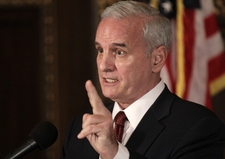
Minnesota Gov. Mark Dayton was clear about his top legislative priority: universal pre-K for the state’s 4-year-olds. His budget proposal included $343 million to fund the initiative, as well as an increase in overall per-pupil education spending.
The House and Senate, however, largely ignored Dayton’s proposals. The House bill would appropriate about $40 million for early-learning scholarships and school readiness programs for at-risk children, and the Senate plan would spend a total of about $75 million on such initiatives. Neither chamber’s budget includes any funds for universal pre-K. The governor strongly rebuked both proposals in a press conference.
NCLB Reauthorization Bill Headed to Senate Floor
A bipartisan bill to overhaul the Elementary and Secondary Education Act (commonly known as No Child Left Behind) is on its way to the Senate floor after education committee members unanimously approved it following three days of debate and amendment. The leaders of the nation’s two largest teachers’ unions — the National Education Association and the American Federation of Teachers —tentatively endorsed the plan and praised the Senate committee for cooperating and passing a bipartisan bill. Read the official summary of the bill here.

Dollar General Youth Literacy Grants provide funding to schools, public libraries and nonprofit organizations to help students who are below grade level or experiencing difficulty reading. Funding is available for implementing new or expanding existing literacy programs; purchasing new technology or equipment to support literacy initiatives, or purchasing books, materials or software for literacy programs. The deadline for application is May 21, 2015. Click here for more information.

Volunteers Provide Critical Support to Young Readers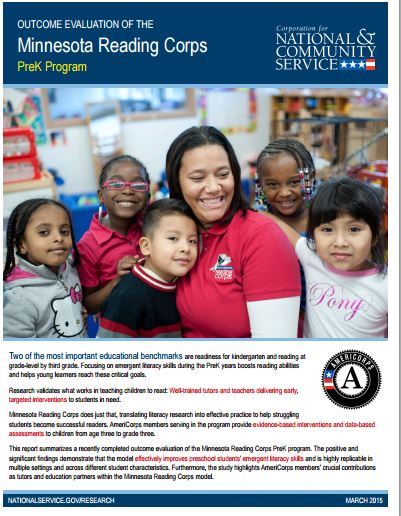
New research finds that volunteers can be instrumental in helping children read proficiently. An evaluation of the Minnesota Reading Corps, which relies on AmeriCorps volunteers to identify and tutor struggling readers, showed that preschoolers in the program were far more likely than other preschoolers to gain the literacy skills necessary for kindergarten. And a new report from MDRC shows that the one-on-one Reading Partners program has a positive impact on reading proficiency.
Literacy Gap between Latino and White Toddlers Starts Early
Latino toddlers whose language comprehension is roughly similar to their white peers at nine months fall significantly behind by age 2, according to a study released by U.C. Berkeley researchers. The study found that about 80 percent of the nation’s Mexican American toddlers were three-to-five months behind their white peers in critical literacy skills.
Access to High-Quality Early Education Programs Still Scarce
“Roughly 6-in-10 four-year-olds are not enrolled in publicly funded preschool programs, and even fewer are enrolled in the highest quality programs,” according to a new report from the U.S. Department of Education. A Matter of Equity: Preschool in America finds that minority children and children from low-income families are the least likely to attend high-quality preschool programs.