 The Campaign for Grade-Level Reading
February 2015
The Campaign for Grade-Level Reading is a collaborative effort by funders, nonprofits, government agencies, business leaders, states and communities across the nation to ensure that many more children from low-income families succeed in school and graduate prepared for college, a career and active citizenship.

National Volunteer Week Offers Opportunity to Recognize Outstanding Reading Tutors
 Promoting greater volunteerism and citizen service to help young children gain reading proficiency has been part of the Campaign for Grade-Level Reading’s agenda from the outset, reflecting the reality that volunteers are essential to reach the large number of children who are at risk.
We will share more in early March, but for now, we are asking communities and partners to send us the names of organizations you work with that provide reading tutors or share your own efforts. We are creating a special web page to honor and celebrate these groups. Photos are welcome, too. Submit the organization names on this form.
Here are some ideas for celebrating National Volunteer Week:
- Plan an event for tutors at a local school or library.
- Use your social media platforms to recognize tutors and organizations.
- Browse the Points of Light Celebrate Service toolkit for ideas and resources.

Get Georgia Reading Director Brings Message to the State House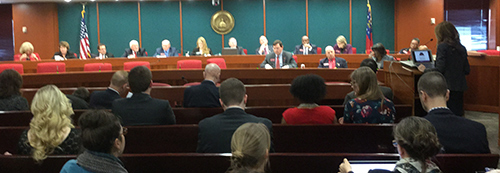
Get Georgia Reading Campaign Director Arianne Weldon spoke to the Georgia House Education Committee on February 6 about the Campaign’s strategy to get every child in Georgia reading proficiently in third grade by 2020. The Campaign, which has brought together hundreds of public and private partners from across the state, is focused on providing babies and young children in Georgia with “language nutrition” and access to high-quality services and literacy programs. Currently, two-thirds of Georgia’s third graders are not reading proficiently.
Weldon was also recently featured in an interview on the White House blog recognizing the “Talk With Me Baby” initiative, which provides early language exposure to babies in Georgia.
February’s Bright Spots Communities Find Innovative Ways to Provide Pre-K to Low-Income Families, Embrace Read Across America Day
Our Bright Spots Communities this month forged creative community partnerships to offer free pre-K programs to low-income families and organized dozens of wide-reaching events for Read Across America Day:
- Gulfport, Mississippi Undeterred by a lack of government funds and school space, South Mississippi PreK4Ward uses private donations and creative locations to provide free full-day pre-K to 132 children across two counties. PreK4Ward serves primarily low-income families — families eligible for Head Start or that just miss eligibility.
- Topeka, Kansas A unique community partnership, including the Topeka Housing Authority and Topeka Public Schools, provides free preschool to children from low-income families in the public housing complex where most live. The first graduates went from scoring as low as the 20th percentile on a pre-K literacy assessment to scoring above the 80th percentile. A summer program was added in 2014.
- Tacoma, Washington, is among many communities nationwide celebrating Read Across America Day on March 2, sponsored by the National Education Association. Tacoma’s community celebration — including 16 events in schools and libraries, some scheduled the Saturday before March 2 — will reach about 2,000 children, over twice as many as last year.

Governors Embrace Third-Grade Reading Initiatives
Eleven governors promised funding to develop or expand preschool and kindergarten  opportunities in their 2015-16 budgets, and many made specific commitments to the cause of third-grade reading. Their proposals demonstrated that grade-level reading is an issue that crosses partisan lines: Washington Gov. Jay Inslee (D) proposed a $2.3 billion investment in early learning, while Michigan Gov. Rick Snyder (R) and Nevada Gov. Brian Sandoval (R) both directly echoed the GLR Campaign in their proposals, noting the significance of the third-grade reading milestone.
Snyder announced on February 11 that he was recommending a $25 million state appropriation in FY 2016 “focused on ensuring Michigan children are reading proficiently by third grade.” He noted that Michigan is one of only five states in which fourth-grade reading proficiency is declining. Sandoval proposed the expansion of all-day kindergarten to every elementary school in Nevada and a statewide push for reading proficiency in his State of the State address.
Abriendo Puertas/Opening Doors Director Sandra Gutierrez Receives Irvine Leadership Award
The James Irvine Foundation this month named Sandra Gutierrez, national program director ofAbriendo Puertas/Opening Doors, a recipient of its 2015 Leadership Award. Abriendo Puertas is working to close the achievement gap in California and across the country with a curriculum that prepares low-income Latino parents to be their children’s first teachers and advocates. Since its launch in Los Angeles in 2007, the program has trained more than 1,000 facilitators and provided its curriculum to more than 37,000 families in hundreds of cities.
“Parents make a huge difference in their child’s early development through small things they can do every day, like talking, singing and reading with them,” Gutierrez said in accepting the award. “But parents need to know what works — and also, their rights and responsibilities.”
Last year, Gutierrez was recognized by the White House as a Cesar Chavez Champion of Changefor her work with Abriendo Puertas.
Home Visiting Services Would Expand under President Obama’s Budget
Along with traditional child care centers and preschool classes, President Barack Obama’s 2016 budget includes a provision to expand home visiting services, which provide one-on-one guidance on child development and healthy parent-child relationships to low-income families. Most research finds that such programs are associated with improved maternal and child health, school readiness and family economic stability. Read more about the proposal and home visiting programs here.

The 2015 Social Innovation Fund grant competition will provide approximately $40 million to eligible institutions seeking to grow innovative, evidence-based solutions to challenges facing low-income communities in the focus areas of healthy futures, youth development and economic opportunity. Last year, the Silicon Valley Community Foundation won a $7.5 million SIF grant to boost third-grade reading proficiency in San Mateo County, California. The application deadline is March 17 at 5 p.m. ET. Click here for more information.

Pre-K Pays Off by Lowering Special Education Placements
Attending state-funded prekindergarten substantially reduces the likelihood that students will end up in special education programs later on, according to a new study by researchers at Duke University. Researchers found that by third grade, children in North Carolina’s state-funded More at Four pre-K program were 32 percent less likely to be placed in a special education program. Moreover, children who were part of Smart Start, a health services program, saw a 10 percent drop in special education placements.

Suspended Students Lose Millions of Instructional Days Each Year
Despite some notable improvements, elementary and secondary suspension rates are still extremely high across the country, and racial gaps open as early as kindergarten, according to new research from the University of California at Los Angeles. The report notes the damaging impact of lost instructional time and calls for discipline reforms to address the racial gap in suspension rates. The report includes a web tool that allows users to see the racial and disability disparities in their school district and compare them to other districts.