 The Campaign for Grade-Level Reading

38 Communities Recognized as Pacesetters for Making Measurable Progress
 Thirty-eight communities across the nation were recognized this month as GLR Pacesetters for “leading by example” to address one or more of the challenges that can undermine early literacy — school readiness, school attendance and summer learning — and/or to improve grade-level reading.
“Pacesetter Honors are among the highest awards presented by the Campaign,” said Ralph Smith, the managing director of the GLR Campaign. “We are very proud of these communities and the numerous organizations and individuals behind them for joining forces and working tirelessly to uplift children and families. They remind us that we are seeing great progress and real results all across the country.”
This year’s Pacesetter communities are located in 20 states and include many first-time honorees.Click here to see the full list of Pacesetters.
Wells Fargo Commits $250,000 to the GLR Campaign
 The GLR Campaign announced this month that it has received a $250,000 grant from Wells Fargo & Company. This new commitment is in addition to a $250,000 grant that Wells Fargo awarded the Campaign in 2013. The investment will enable the Campaign to capitalize on progress to date and strengthen the guidance, tools and resources provided to GLR communities.
“Wells Fargo recognizes the fundamental importance of early literacy in providing all children a gateway to success in school and life. For children in low-income families, the stakes are even higher and the challenges much greater,” said Mike Rizer, executive vice president and head of Community Relations for Wells Fargo. “We are proud to partner with the Campaign and help accelerate its progress toward accomplishing this vital mission.”
Click here to read the GLR Campaign’s press release.
Still Time to Register for the 3rd Annual Funder-to-Funder Huddle!
Current and prospective grade-level reading funders are encouraged to register for the GLR Campaign’s 3rd Annual Funder-to-Funder Huddle on April 7-8, 2016, in Washington, D.C. This is a great opportunity for funders of GLR-related efforts to meet, learn, share challenges and successes and work together to produce results. Find the current agenda, featured speakers, hotel information and more on this page.
To register, funders should click on the phrase below that best describes their organization’s role:
- Funding a GLR community or state
- Funding the nationwide GLR enterprise structure
- United Way funding a GLR community

GLR Communities Celebrate Read Across America Day
March 2 was Read Across America Day, the annual celebration of reading and Dr. Seuss’s birthday, and GLR communities across the country held events to mark the occasion. The GLR Campaignkicked off the day at Dr. Ethel D. Allen Promise Academy in Philadelphia, joined by Principal Stefan Feaster-Eberhardt and a third-grade class. Our friends from Wells Fargo joined us to present a $250,000 check to the GLR Campaign (see above) and a $100,000 check to the local READ! by 4thCampaign.
Click here to read a full recap of the day’s festivities!
Governors Reinforce GLR Priorities in Addresses
Governors from across the nation made strong cases for grade-level reading in their annual addresses to state legislatures in January and February. Six governors — Butch Otter (R), Idaho; Phil Bryant (R), Mississippi; Susan Martinez (R), New Mexico; Mary Fallin (R), Oklahoma; Nikki Haley (R), South Carolina, and Bill Haslam (R), Tennessee — made explicit references to third-grade reading, and 17 more referenced policy priorities important to the GLR Campaign. Many praised statewide efforts to improve early learning and get all children reading on grade level by third grade.

Federal Government Will Commit Emergency Funds to Head Start in Flint
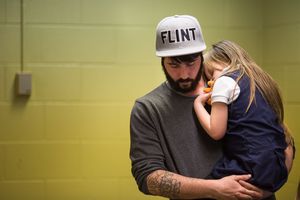 The U.S. Department of Health and Human Services (HHS)announced this month that it would commit $3.6 million in emergency funds to expand Head Start and Early Start programs for Flint preschoolers affected by the city’s lead-contaminated water supply. The funds will be used to open additional classrooms and lengthen the school year by three weeks. HHS says there is currently a Head Start waitlist of around 800 children in Flint.
Leading Association of Physicians Calls for Action on Child Poverty
The American Academy of Pediatrics (AAP), which represents some 64,000 pediatricians, called for doctors in the United States to screen children for poverty in an effort to reduce its health effects. Accompanying the new recommendations is a technical report finding that children who grow up in low-income families have higher rates of chronic illnesses, lower vaccination rates and higher rates of infant mortality. AAP also urged pediatricians to advocate for public policies that support children’s health and fight poverty, such as job training or a higher minimum wage.
Massachusetts Committee Endorses Summer Learning Bill
The Massachusetts Joint Committee on Education this month endorsed a bill that would create a pilot grant program to expand evidence-based summer learning opportunities in high-poverty school districts. The bill has received support from Boston Mayor Martin Walsh, Worcester Mayor Joe Petty, former Massachusetts Secretary of Education Paul Reville and YMCA of Greater Boston President and CEO James Morton. Morton testified in favor of the bill, arguing that 60 to 75 percent of the achievement gap between low-income students and their wealthier peers can be attributed to summer learning loss.

The Express Scripts Foundation funds state and local initiatives that support school readiness and improve literacy to help prepare underserved youth for higher education and success in life. Grant amounts range from $500–$200,000. Deadlines are March 1, June 1, September 1 and December 1, annually.

Mississippi Child Care Facilities Lack Oversight
The oversight and regulation of child care facilities in Mississippi is weak and varies widely by location, according to a new report from The Hechinger Report and Clarion Ledger. A surveyconducted by the two publications finds that the state’s policies for investigating claims of abuse or neglect are applied inconsistently and can be confusing for parents to navigate. The report argues that the issue of weak child care regulation is common to many states.
Public Early Education Improves Kids’ Outcomes in Baltimore
 The Baltimore Education Research Consortium this month released a new brief finding that Baltimore children who did not enroll in publicly funded early education programs were less likely to be ready for kindergarten and more likely to be chronically absent. Kindergarten Attendance and Readiness for Baltimore’s Class of 2027 also finds that programs such as Head Start or public pre-K were most beneficial for students whose parents did not complete high school.