 The Campaign for Grade-Level Reading
May 2015
The Campaign for Grade-Level Reading is a collaborative effort by funders, nonprofits, government agencies, business leaders, states and communities across the nation to ensure that many more children from low-income families succeed in school and graduate prepared for college, a career and active citizenship.

Take the Summer Learning Pledge
As school comes to an end for students across the country, GLR communities are turning their attention to summer learning loss. The “summer slide” is particularly acute among low-income students, who lose an average of more than two months in reading achievement over the summer.
This year, Summer Learning Day will be observed on June 19. In celebration, the National Summer Learning Association (NSLA) and the GLR Campaign are challenging everyone—programs, families, schools, educators, policymakers, businesses—to make summer a season of learning for all children by pledging to #KeepKidsLearning. Communities can find tools and resources on NSLA’s website and share events on the interactive Summer Learning Day map.
Take the pledge now, and spread the word with others in your network! If you are taking the pledge on behalf of a GLR community or program, please be sure to indicate that on the pledge form.
New Funder Toolkit Highlights GLR Work

Last week, The Center for High Impact Philanthropy at the University of Pennsylvania released an updated and expanded version of Invest in a Strong Start: An Early Childhood Toolkit for Donors. The toolkit provides a comprehensive but focused overview of high-impact investment opportunities and strategies for funders interested in early childhood.
The toolkit identifies a focus on early reading as a highly effective strategy for donors, citing the GLR Campaign’s research. The Campaign is noted as a critical source of information and funder-to-funder connections in early reading. Key GLR Partners like Reach Out and Read, Reading Is Fundamentaland BELL (Building Educated Leaders for Life) also are identified as high-impact programs.
Read our blog post about the toolkit here.

PBS and CPB Honored as Pacesetter Partners
PBS and the Corporation for Public Broadcasting (CPB) were recognized this month as 2014 Pacesetter Partners by the GLR Campaign, cited for their long-standing and rich contributions to early learning and grade-level reading. The two organizations were honored at PBS’s Annual Meeting with member stations from across the country.
“The Campaign is privileged to have these leaders in education among our most valued partners in the effort to ensure that more children from low-income families get the start they need on the path to school and life success,” said Ralph Smith, managing director of the GLR Campaign. “PBS — with support from CPB — is unmatched as a source of outstanding educational content for millions of young children, parents and early educators.”
Education Week Piece Spotlights Three GLR Pacesetter Communitie
Education Week this month published an extensive report on the state of early literacy and reading instruction in the United States. One piece of that report called out three 2014 Pacesetter communities — New Britain, Connecticut; Topeka, Kansas, and Quad Cities, Illinois and Iowa —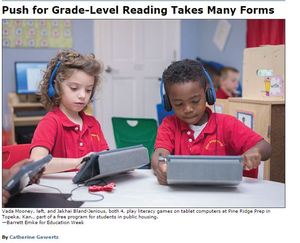 for their outstanding work in the GLR Campaign’s three focus areas of attendance, school readiness and summer learning.
The piece was a reminder that GLR communities across the country are setting the bar for quality early literacy efforts. From New Britain’s intensive absence reporting program to Topeka’s public housing preschool initiative to Quad Cities’ innovative summer enrichment programs, these communities are making measurable progress in preparing all children to read proficiently by the end of third grade.
May’s Bright Spots Communities Expand Reading Opportunities to More Families
Our Bright Spots Communities this month are reaching more local families by matching peer reading tutors, engaging families in public housing complexes and expanding summer learning programs:
- Springfield, Massachusetts: This 2014 Pacesetter community is reaching more than 300 children and their parents through Talk/Read/Succeed!, an early literacy effort that works directly with families living in public housing to address their needs.
- Houston, Texas: Five hundred students in 15 Houston-area elementary schools participate in a peer-to-peer reading tutoring program that matches trained fourth- and fifth-grade tutors with second- and third-grade tutees. The program is supported by United Way of Greater Houston, a member of the local grade-level reading coalition.
- Kansas City, Missouri: In 2015, free summer learning programs will be available for nearly 16,000 children in 20 elementary schools and other sites in the Kansas City Public Schools — more than twice the 2014 enrollment.

Stanislaus READS Kicks Off in Stanislaus County, California
More than 60 percent of third graders in Stanislaus County, California, are not reading at grade level — but a new community effort aims to change that. The Stanislaus READS initiative soon will begin to test early literacy programs at five schools in the area after a report found that just 30 percent of third graders from low-income families were reading at grade level. The Stanislaus Community Foundation is spearheading the effort with the county Office of Education, Head Start, Stanislaus County Library and the Children and Families Commission.
Alabama House Votes to Expand State Pre-Kindergarten Program
The Alabama House of Representatives this month voted unanimously to appropriate $48.5 million for the state’s First Class Pre-K program, a $10 million increase over last year’s amount. The Senate already approved a version of the legislation, but will have to approve changes that were made by the House. If signed into law, the funding would help open at least 100 new classrooms and provide as many as 1,800 more 4-year-olds with access to the state’s voluntary pre-kindergarten program, according to the Alabama School Readiness Alliance.
Minnesota Governor Vetoes Education Budget for Lack of Pre-Kindergarten Funds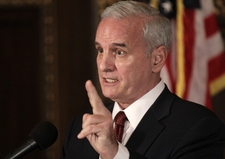
Minnesota Governor Mark Dayton followed through on his promise to veto the state legislature’s education budget. He says lawmakers need to provide more money for the statewide pre-kindergarten program he’s made a top legislative priority. Earlier this month, Dayton recommended $150 million in additional spending for the program, but the legislature elected not to fund the initiative at all.
“It is astonishing that with a $1.9 billion surplus, and more than $1 billion left…for future tax cuts, there would be less invested in our schools this year,” Dayton wrote in a letter to House Republican Speaker Kurt Daudt. He will call the legislature back for a special session to try again.
Head Start Celebrates 50 Years
Head Start celebrated its 50-year anniversary this month. The program, which provides comprehensive early childhood services to low-income children and their families, is recognizing the occasion with events and celebrations throughout the year. Since its creation in 1965, more than 31 million children have participated in Head Start programs nationwide.

W.K. Kellogg Foundation Announces $2.4 Million Grant for Summer Reading in Mississippi
With many Mississippi third graders facing retention after failing state reading exams this year, the W.K. Kellogg Foundation announced a three-year $2.4 million grant that will be channeled through the National Board for Professional Teaching Standards. Through the effort, board-certified teachers will become literacy coaches and mentor other teachers to enhance their ability to teach reading.

Expanded Preschool Could Save California Millions in the Long Run
California could save close to $820 million per year by providing preschool for an additional 31,500 low-income 4-year-olds, according to a new report from business organization ReadyNation. You Get More Than What You Pay For finds that providing expanded high-quality early childhood education could save the state an average of $26,000 per child from less grade repetition, fewer special education placements, increased lifetime earnings and other factors.
At-Risk Children Benefit from Access to Nonfiction and Informational Texts over the Summer
Reading Is Fundamental conducted a broad research study to test the efficacy of its Read for Success model, which aims to reduce summer learning loss in children from low-income communities by providing access to nonfiction and informational texts. The study found that nearly 60 percent of students in the program improved their reading proficiency, with low performers showing the greatest gains. See the full report here.
Maryland Kindergartners Face Large Gaps in School Readines
Nearly half of the kindergartners entering Maryland schools in the fall of 2014 were fully ready for learning — but there were large readiness gaps by income, race and other factors, according to data from the state’s new Kindergarten Readiness Assessment. For example, 36 percent of children in low-income families entered kindergarten fully prepared, compared with 57 percent of children from middle- and upper-income families. Black and Hispanic students also faced large readiness gaps when compared with their white peers.