 The Campaign for Grade-Level Reading
November 2013
The GLR Campaign is a collaborative effort by foundations, nonprofit partners, states and communities across the nation to ensure that more children in low-income families succeed in school and graduate prepared for college, a career and active citizenship.

GLR Campaign Policy Director Elected to Denver Public Schools Board
Barbara O’Brien, the former Colorado lieutenant governor who has been a leader in setting the 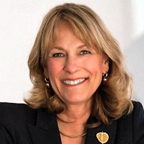 policy direction for the GLR Campaign, was elected Nov. 5 to the Denver Public Schools Board. In her campaign, O’Brien pledged to increase support for students and teachers to meet reading and math standards in the early grades and to fund summer and after-school programs. O’Brien was instrumental in pushing for state passage of the Read Act, which promotes early reading with assessment and intervention in the early grades. She is currently president of Get Smart Schools.
Spread the Word About the GLR Newsletter
We hope you enjoy this month’s newsletter. If you do, share it with a friend or colleague who cares about third-grade reading. We would like to reach more educators, advocates, community-based organizations, business leaders, faith-based groups — anyone engaged in helping vulnerable children from birth through age 8. Right now we have 4,800+ newsletter subscribers. We would love to make it 5,000 by the end of this month. So pass the newsletter along and encourage people to sign up at: https://gradelevelreading.net/copy/about-us/contact-us.

Two GLR Communities Recognized for Outstanding Summer Learning Programs
Two summer learning programs in GLR communities, the Boston Summer Learning Project and Freedom School Partners in Charlotte, N.C., received the New York Life Excellence in Summer Learning Award this month for providing high-quality educational programs.
The Boston Summer Learning Project provides full-day, integrated learning experiences at a number of elementary, middle and high schools throughout the region. Each program is tailored to the specific needs and interests of its children, but all are centered on the common goals of academic progress in reading and math skills.
In Charlotte, the Freedom School Partners program provided summer learning programs to 1,200 scholars in 19 sites throughout the community this year. Freedom Schools, part of a nationwide initiative sponsored by the Children’s Defense Fund, provide programs led by college students that serve children who otherwise could not afford such opportunities.
State Forums Focus on Third-Grade Reading
Poised to join the GLR Campaign, Idaho leaders and advocates hosted a Nov. 15 summit to explore what it takes to ensure that more children master reading by the end of third grade. The Idaho Literacy and Reading Summit drew 400 teachers, business leaders and policymakers to discuss early reading, as well as a $350 million to $400 million list of education reform recommendations from a gubernatorial task force.
In Atlanta, the Georgia Campaign for Grade-Level Reading held a two-day event in November to develop its theory of change for improving outcomes for Georgia’s students. The event capped off a series of “learning journeys” to sites across the state where Campaign members visited: a school district that has shown dramatic increases in third-grade test scores and graduation rates; a children’s hospital where health needs are managed systematically; a parent engagement program for refugee families; a dual-language immersion charter school; a school using Gov. Nathan Deal’s Reading Mentor program; and others. Read more here.
To share updates on your community’s efforts, email Phyllis Jordan at pjordan@gradelevelreading.net.

New Legislation Emphasizes Pre-K Quality and Access
Congressional leaders introduced new legislation this month that would distribute more than $27 billion in federal funds to states for early care and education. The Strong Start for America’s Children Act would divide funding among states in proportion to each state’s share of 4-year-olds from low-income families as compared to that state’s population of all 4-year-olds. The bill aims to:
- Accelerate states’ efforts to provide high-quality preschool to low- and moderate-income families
- Increase the quality of infant and toddler care in center-based and family child care settings
- Ensure that Child Care and Development Block Grants support programs that improve the health, safety and school readiness of children
- Encourage continued support for the Maternal, Infant and Early Childhood Home Visiting program.
NAEP Scores Show Gains in Some Places
The 2013 Nation’s Report Card, released in November, showed little progress on fourth-grade reading scores nationally, but significant gains occurred in nine places: Colorado, the District of Columbia, Indiana, Iowa, Maine, Minnesota, Tennessee, Washington and the Department of Defense schools.
Digging deeper into proficiency rates for students living in poverty, we found some interesting trends. In 33 states and D.C., the proportion of fourth graders reading proficiently increased in the past two years. West Virginia, Iowa and Florida showed particularly strong increases.
We remain encouraged by the energy and commitment we see across the country to ensure that children from low-income families master reading by the end of third grade. With dozens of states and communities putting a stake in the ground on this issue — bringing together policymakers, civic leaders, educators, nonprofits and philanthropy — we have a real opportunity to improve early reading.
Stay on top of all that is new with the Campaign and with the progress of grade-level reading by making regular visits to our website: www.gradelevelreading.net. The site offers a comprehensive news source on issues related to early childhood, reading development and achievement. Additionally, get the latest updates on federal initiatives and state campaigns and read recent studies on child development and literacy.

Organizations Aligned with GLR Work Picked for I3 Grants
The U.S. Education Department has named the top 25 applicants in the latest round of its Investing in Innovation (I3) program, a list that includes several organizations working in GLR Network communities or closely aligned with our work. The potential grantees must secure matching funds by Dec. 11 to receive part of the $135 million in federal funding available for the I3 program. Those connected to our work or communities include:
- United Way of Greater Atlanta seeks to launch Partners Advancing Childhood Education, an innovative approach to early childhood education that uses family engagement and family-school partnerships to improve outcomes from Pre-K to grade 3.
- The Children’s Aid Society seeks to expand its Parent Leadership Institute into New York City’s South Bronx community, bringing a full set of parent engagement strategies to the disadvantaged neighborhood.
- The Providence Plan plans to implement Empowering Families, a project that builds the capacity of families with children in grades K-3 to support their children’s social-emotional and cognitive development.
- Pennsylvania State University plans to develop a model in Chicago Public Schools to promote social-emotional learning among children from low-income families.
- Waterford Institute seeks to expand its home-based UPSTART project in rural Utah school districts to improve school readiness preparation and reading development. The curriculum also will be used in summers after kindergarten and first and second grade.
- Casa de Maryland plans to launch initiatives that train parents and families with limited English proficiency to support their children and improve academic outcomes in the Langley Park Promise Neighborhood near Washington, D.C.
Fresno Regional Foundation Awards $575,000 for Early Reading Programs
The Fresno Regional Foundation, which serves six counties in central California, last week announced $575,000 in grants for programs working to improve early literacy. The grants mark the second year that the Foundation’s Fund for the San Joaquin Valley has targeted third-grade reading.
“Whether it was crime, poverty, unemployment or the environment, it all kept pointing to early intervention and preparing a child for success by the third grade,” Angie Cisneros, a member of the grants committee, told the Fresno Bee. The grant recipients include:
- Reading and Beyond, Building Foundations for Children and Families in Fresno: $200,000 for its Grade-Level Reading Program.
- Cutler-Orosi Joint Unified School District in Tulare County: $200,000 for its Cutler-Orosi Family Literacy Project.
- Center for Transnational Health, University of California, Davis: $100,000 for “Puente Cultural: Bridging Cultures to Close the Latino Achievement Gap” in five school districts.
- Woodlake Family Resource Center in Tulare County: $75,000 for its Path to Literacy project.
Last year, the Fund awarded $600,000 in grants focused on early childhood. The Fund, a partnership among local donors, was started with a $3 million investment by the James Irvine Foundation. The Fresno Regional Foundation is raising money to build a permanent endowment that can commit to as much as $1 million in grants annually.

The First Eight Years: Giving Kids a Foundation for Lifetime Success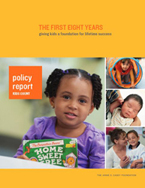
The Annie E. Casey Foundation’s latest KIDS COUNT policy report presents a strong case for investing in the early years of a child’s life. Decades of brain and child development research show that kids who enter kindergarten with below-average language and cognitive skills can catch up — but only if they are physically healthy and have strong social and emotional skills.
The Vital Link: Early Childhood Investment is the First Step to High School Graduation
This Ready Nation brief looks at recent research that shows the crucial link between early childhood education and high school graduation. The research confirms that children not ready for kindergarten can be half as likely to read well by third grade. Children not reading well by third grade are, in turn, four times more likely to drop out of high school.